
Basement flooring in Lexington, KY: what actually holds up below grade
Luxury vinyl plank with an SPC core and porcelain tile are the two floors we trust in a Central Kentucky basement. Here is how every other material behaves once it meets a damp slab, and how to test yours before you spend a dollar.

What’s in this guide
The short answer
- SPC luxury vinyl plank is the right call for finished living space. Fully waterproof, stable to 95% humidity, warm underfoot.
- Porcelain tile is the fifty year option for bathrooms, wet bars and laundry. A flood does not hurt it.
- Test the slab before you buy anything. Over 3 pounds per 1,000 square feet and your options narrow. Over 5 and you have a water problem, not a flooring problem.
- Laminate, broadloom carpet and most engineered hardwood do not last below grade in Kentucky. We have torn out plenty of all three.
We’re Elite Floors, out of Nicholasville. We install basement floors across Lexington, Jessamine County and the rest of Central Kentucky, and a good share of that work is tearing out somebody else’s.
A homeowner puts thousands into engineered hardwood and watches it cup and separate inside of eighteen months. Laminate that looked flawless on install day buckles into waves after one humid August.
The floor didn’t fail because it was cheap. It failed because nobody tested the slab.
Basement flooring compared
Nine materials, ranked by how they actually behave below grade in a Kentucky home rather than how they perform in a showroom.
Swipe the table sideways to see every column.
| Material | Waterproof | Lifespan below grade | Underfoot | Best for |
|---|---|---|---|---|
| LVP (SPC core)Top pick | Yes | 15 to 25 yrs | Warm, slight give | Living space, offices, playrooms |
| Porcelain / ceramic tileTop pick | Yes | 50+ yrs | Cold, hard | Bathrooms, wet bars, laundry |
| Sheet vinyl / VCT | Yes | 10 to 20 yrs | Cold, thin | Laundry, storage, workshops |
| Rubber tile (8mm+) | Yes | 20+ yrs | Cushioned | Home gyms, play areas |
| Epoxy | Yes | 20+ yrs | Hard, cold | Workshops, basement bars |
| Polished concrete | Yes | 20+ yrs | Hard, cold | Storage, industrial look spaces |
| Engineered hardwood | No | 5 to 15 yrs, risky | Warm | Dry basements only, dehumidified |
| Laminate | No | 2 to 5 yrs | Warm | We don’t install it below grade |
| Carpet | No | Varies, mold risk | Warmest | Carpet tile only, dry slabs only |
Every one of these is quoted by the project. What your basement needs before the floor goes down matters as much as which floor you pick.
Why basements are hard on flooring in Central Kentucky
Moisture gets at a basement floor five ways: groundwater pushing up against the slab, water vapor moving through the concrete itself, high air humidity, seasonal temperature swings, and the occasional burst supply line or backed up drain.
Water vapor is the one people miss. An untreated slab can push 5 to 12 pounds of moisture per 1,000 square feet per 24 hours up through concrete that looks perfectly dry. Most flooring adhesives give up above 3 pounds. That’s the ASTM F1869 threshold, and it isn’t a suggestion. Go over it with a glue down floor and you’ve bought yourself a callback.
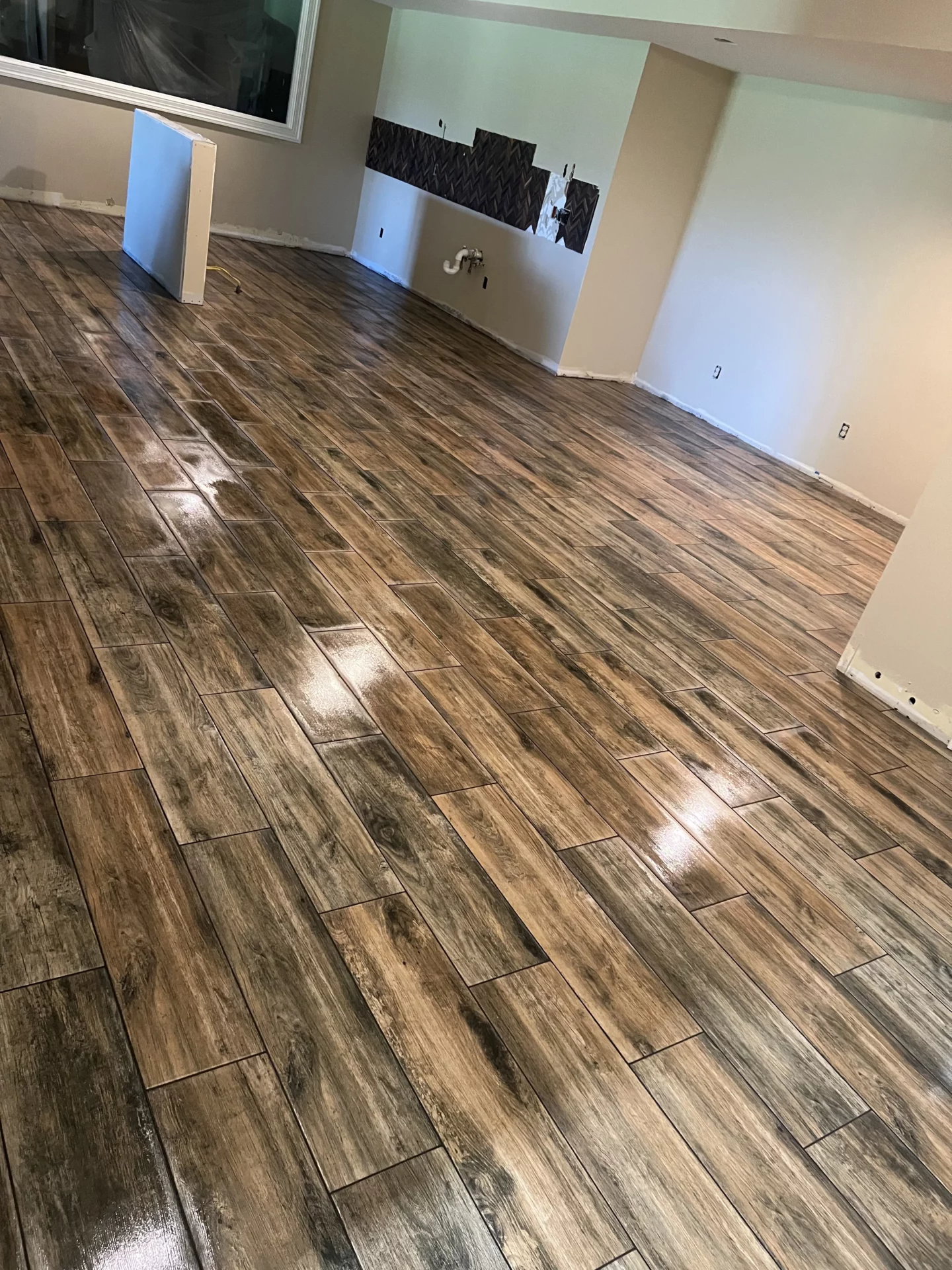
Then there’s condensation. At 65°F and 70% relative humidity, basement air hits its dew point at 54°F. A slab sitting on 50°F ground is colder than that, so moisture condenses on it. No leak required.
Our soil makes all of it worse. Central Kentucky clay swells when it’s wet and shrinks when it dries, so foundations here are never quite still. We’ve measured seasonal slab movement up to an eighth of an inch in older Lexington homes. That’s enough to crack grout and pop a glued plank loose.
Test the slab before you buy anything
Before we quote a basement job, we test. So should you, even if you’re doing the work yourself.
The calcium chloride test (ASTM F1869)
This is the cheap version, and any flooring supplier sells the kits. You tape the dish to a clean patch of slab, seal it under the dome, leave it 60 to 72 hours, weigh it, and calculate the emission rate.
- Under 3 pounds per 1,000 square feet and most flooring is fine.
- Between 3 and 5 you’re looking at LVP or tile with a vapor barrier.
- Over 5, stop. Fix the water first: exterior drainage, a sump pump, a dehumidifier.
Flooring installed over an unsolved water problem is just an expensive lid.
The in situ relative humidity test (ASTM F2170)
Most manufacturers now want this one instead. Probes go into holes drilled in the slab and sit for 72 hours. It reads the whole depth of the concrete rather than just the surface, and on modern low permeability slabs it’s the more honest number. If your warranty depends on a moisture reading, this is usually the one the manufacturer will accept. We run F2170 on any glue down job.
Test in spring. March and April are when ground saturation peaks around here. Numbers that look good in April tend to hold up the rest of the year.
We tested a basement in early 2022 that the homeowner swore was bone dry. It came back at 8.2 pounds per 1,000 square feet. He’d already picked out laminate. That floor would have been waves by Christmas.
We put down SPC luxury vinyl over a 6 mil poly vapor barrier instead, and it hasn’t moved since.
Not sure what your slab is doing?
We test moisture and flatness as part of every basement estimate, before you spend anything on material.
Luxury vinyl plank: the one we recommend most
SPC luxury vinyl plank is fully waterproof and holds its dimensions in humidity up to 95%. For a finished basement people actually live in, it’s the right answer more often than anything else.
SPC means stone plastic composite. The core is rigid, so it doesn’t swell or shrink when the basement gets muggy. WPC, the wood plastic composite version, feels softer underfoot but isn’t as stable. Below grade, we go SPC every time. Our full LVP flooring installation service covers the rest of the house too.
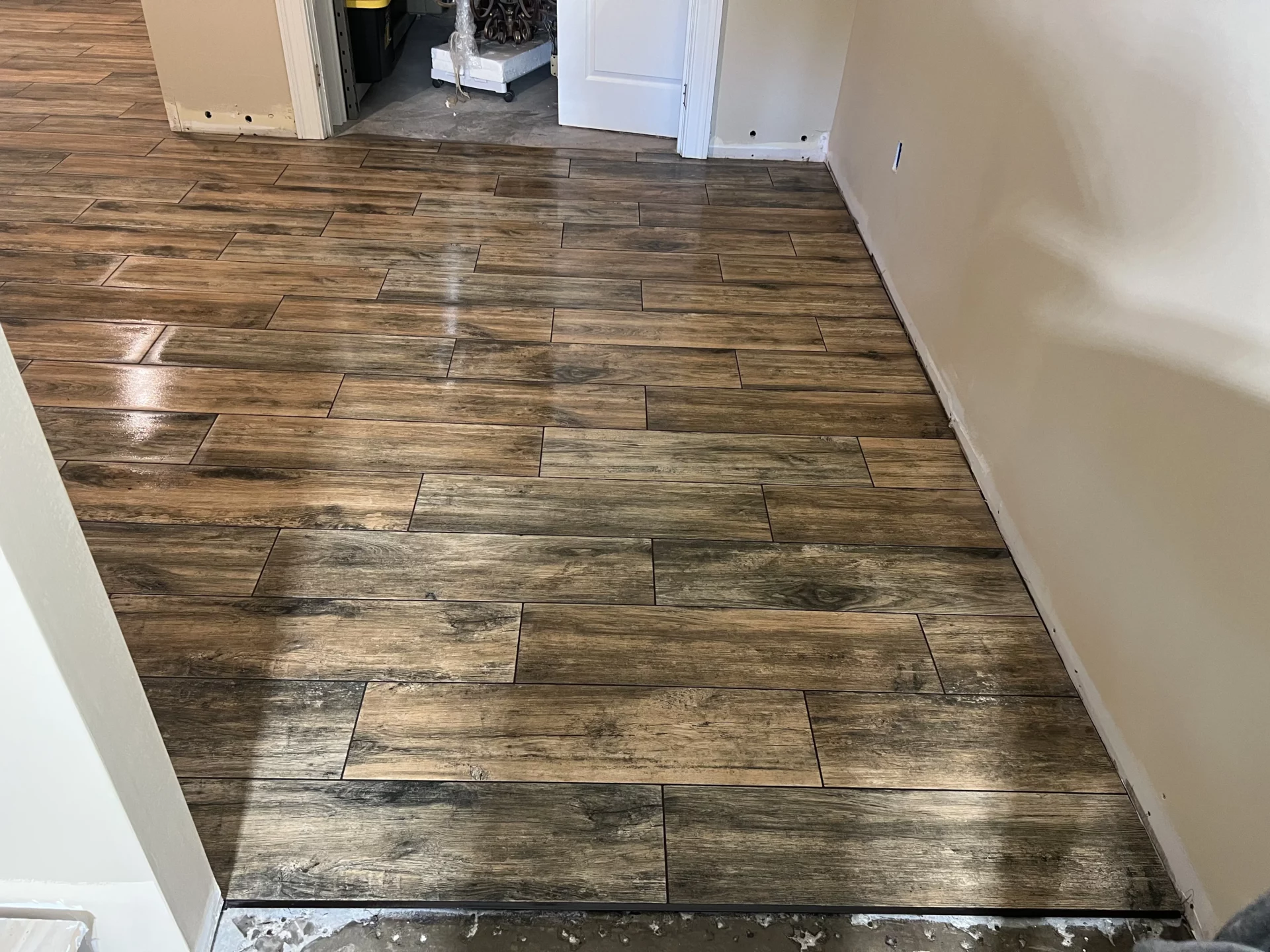
What to look for
- Wear layer sets the lifespan. 0.3mm holds up 10 to 15 years under normal traffic. 0.5mm gets you 15 to 20. At 0.7mm you’re past 20 years, and that’s what we spec for basements with kids and dogs.
- Click lock or glue down. Floating installs go fastest and forgive a slab that isn’t perfectly flat. Glue down feels more solid underfoot, but the slab has to test under 3 pounds. Which one your basement gets depends on the slab, and it affects the quote.
- Leave a quarter inch expansion gap at every wall. Homeowners install it tight, the floor has nowhere to go when it moves, and it humps up in the middle of the room. It’s the most common DIY failure we fix.
- Warm wood tones are what people are picking. Honey, caramel, chestnut. The gray washed look has cooled off.
Good
- Waterproof and warmer than tile
- Huge range of looks
- DIY friendly if the slab is level
Not so good
- Heavy furniture can dent it
- Scratches show on dark colors
- Glue down needs a dry slab
Porcelain and ceramic tile: the fifty year option
Tile is waterproof, lasts 50 years or more, and shrugs off a flood. If a pipe lets go, you dry it and move on.
Porcelain absorbs under 0.5% water. Ceramic is 3% to 7%. In a basement with any moisture history, we use porcelain. Large format tile, 12×24 and up, means fewer grout lines but demands a genuinely flat substrate, so we grind or self level first to keep the tile edges flush. That prep is the single biggest variable in what a tile installation costs in a basement, which is why we look before we quote.
Grout matters more than people expect. Sanded for joints wider than an eighth of an inch, unsanded for tighter ones. Epoxy grout costs more, never needs sealing, and doesn’t stain. In a basement bathroom, it’s worth the upcharge.
If your basement runs cold, electric radiant mat under the tile completely changes how the room feels in January. We’ll show it as a line item on your estimate so you can decide either way.
Good
- Waterproof and essentially permanent
- Floods don’t hurt it
- Nothing dents or scratches it
Not so good
- Cold and hard underfoot
- Cement grout needs periodic sealing
- Not a weekend project
Vinyl, rubber, epoxy and polished concrete
Not every basement is a family room. Laundry rooms, gyms, workshops and bars each have a floor that suits them better than LVP does.
Sheet vinyl and VCT: the budget waterproof floor
Sheet vinyl is the most affordable waterproof option we install. It comes in 12 foot rolls with heat welded seams, so there’s almost nowhere for water to get in. We’ve put sheet vinyl over slabs reading 6 pounds per 1,000 square feet without trouble, because the vinyl itself is impermeable. Moisture can’t reach anything it would damage.
The trade off is honest: it looks like budget flooring. Fine for a laundry room, a workshop, storage. Not what you want in a family room. VCT is the commercial cousin, usually 12×12 squares set in adhesive. Durable, handles moisture, and looks like a school hallway.
Rubber flooring: basement gyms
Interlocking rubber tile is the obvious call for a basement gym. Waterproof, absorbs impact, and lasts past 20 years. The 2×2 tiles go down without adhesive, which makes this the most DIY friendly floor on this page.
Thickness follows what you’re dropping. 8mm minimum for general gym use, 10mm if you’re powerlifting, three quarter inch if barbells come down from overhead. Expect a rubber smell for the first two to four weeks. It fades.
Epoxy and polished concrete
Epoxy is a two part resin that bonds chemically to prepared concrete and leaves a seamless waterproof surface. Prep is where these jobs are won or lost. The slab gets ground clean, every trace of oil comes out, cracks get filled. Skip that and it peels. It also means the condition of your existing slab drives the quote more than the coating does.
Polished concrete grinds the slab down to expose the aggregate, then seals it. Both last 20 years and up. Both are hard and sound reflective, which makes them poor choices for a basement bedroom or TV room and good ones for a workshop or a basement bar. Color dyes, metallic epoxy and flake systems give you options beyond plain gray. For walkouts and exterior approaches we also install pavers and stone and brick.
The floors that fail below grade
We get paid to install floors, so take it seriously when we tell you not to buy one. These three account for nearly every basement tear out we do.
Engineered hardwood
ConditionalIt can work below grade if your slab tests under 3 pounds and you run a dehumidifier year round. We’ll install it when conditions justify it, and we’ll tell you when they don’t. It’s a hardwood veneer over a plywood core, more stable than solid wood but still made of wood, so we float it rather than glue it and let it move a little with the seasons.
Here’s our actual experience. In the last five years we’ve torn out at least a dozen engineered wood basement floors around Lexington. Every one had cupped at the seams inside eighteen months. Only laminate has cost our customers more money.
Laminate
We won’t install itLaminate fails in most basements within two to five years, and we no longer put it in one. The core is high density fiberboard, which is compressed wood fiber. Once moisture gets past the wear layer through a seam, an edge or a scratch, that core swells. It’ll look fine for months and then go to waves overnight.
There’s waterproof laminate now with sealed cores. Maybe it works. It hasn’t been in the ground long enough for us to stake a customer’s basement on it. Above grade is a different story, and we install plenty of it.
Carpet
Carpet tile or nothingBroadloom carpet over a basement slab is a mistake we get called to remove. The pad holds moisture against the concrete, mold sets up underneath where you can’t see it, and the smell arrives before the visible damage does.
Carpet tile is the exception worth considering. Modular tiles with an impermeable backing sit directly on the slab with no pad. If a water heater lets go, you pull the wet tiles, dry the slab and drop in replacements from the same box. It’s warm, it’s quiet, and it’s the only carpet we’ll put below grade, and only on a slab that tests dry.
Subfloor panels: worth it or not?
Dimpled subfloor panels, the kind you’ll see sold as DRIcore or Delta FL, are tongue and groove panels with a raised plastic underside. They create an air gap between your finished floor and the concrete, which gives vapor somewhere to go and puts a thermal break under your feet. In an unheated Kentucky basement, the temperature difference is noticeable.
Two things to know before you commit. They raise the finished floor close to an inch, which matters if you’re already tight on headroom or fighting a stair riser. And they manage vapor, they don’t stop water. If your slab is testing over 5 pounds, panels are not the fix.
We spec them most often under LVP in basements that will be used as real living space, and we’ll show them as a line item on your estimate so you can decide.
How we quote a basement floor
We don’t price basements over the phone, and we’d be guessing if we did. Two basements the same size can be very different jobs.
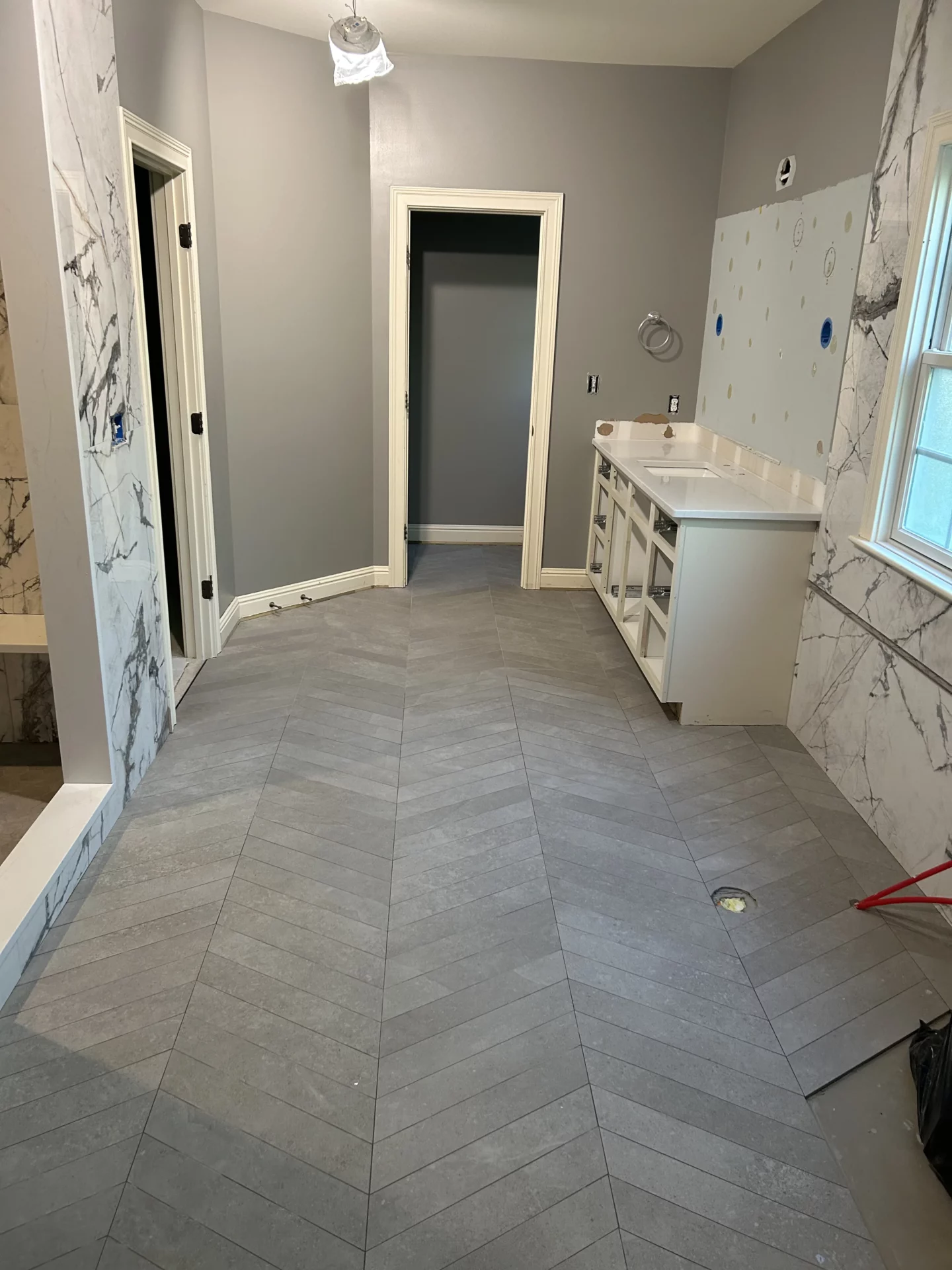
What moves the number is the slab. How much grinding, self leveling or crack repair it needs before anything goes down. Whether the moisture reading calls for a vapor barrier or a full drainage fix first. Whether we’re floating or gluing. Whether there’s an old floor to tear out and haul away, how many transitions and stair nosings are involved, and how the room is cut up.
So we come out, test, measure, and put it in writing. The estimate separates prep from flooring so you can see exactly what you’re paying for and where you have choices. If a material you liked doesn’t suit your slab, we’ll tell you before you’re committed to it.
How a basement job runs
- We come out and test the slab, both moisture and flatness, before we talk materials.
- You get a written quote that separates prep from flooring.
- Prep happens first, whatever it takes to get the slab flat and dry enough for the floor you picked.
- Then we install, and we leave the expansion gaps and transitions where they belong.
If the test says your basement isn’t ready for flooring yet, we’ll say so. We’d rather lose the job than warranty a floor over standing moisture.
Elite Floors LLC, Nicholasville KYWhere we work
Elite Floors installs basement flooring in Nicholasville, Lexington, Georgetown, Versailles, Richmond and the surrounding Central Kentucky communities. Call (859) 553-6259 to confirm scheduling for your address.
Basement flooring questions we get asked
SPC luxury vinyl plank for finished living space, porcelain tile for bathrooms and anywhere water is likely. Both are fully waterproof and both handle the humidity swings we get here.
Yes, if the slab is dry enough and flat enough. LVP, tile, sheet vinyl and rubber all go directly onto concrete. Test the moisture first and level anything more than about an eighth of an inch out over ten feet.
If your slab tests between 3 and 5 pounds per 1,000 square feet, yes. We use 6 mil poly under floating floors. Under 3 pounds you often don’t need one, and over 5 pounds a vapor barrier isn’t enough on its own.
We don’t recommend it. The fiberboard core swells once moisture reaches it, and in most Central Kentucky basements it does within two to five years.
By the project, after we’ve seen the slab. Material choice is only part of it. Moisture readings, how flat the concrete is, tear out of an old floor and the layout of the room all change the work involved. We test and measure in person, then give you a written estimate with prep and flooring listed separately.
Tile, epoxy and polished concrete are cold underfoot. LVP is noticeably warmer, and warmer still over a dimpled subfloor panel. Electric radiant mat under tile solves it outright, and we can quote it as an option.
Tile, epoxy, sheet vinyl and rubber can be dried and reused. Floating LVP usually survives if water is extracted quickly, though the underlayment may need replacing. Laminate, engineered hardwood and broadloom carpet generally don’t come back.
Most LVP basements take one to two days once prep is done. Tile runs three to five days including cure time. Slab prep adds a day or more depending on what we find.
Test the slab, then pick the material. Do it in that order and the floor lasts twenty years instead of two.
We’ll test your slab at no charge, measure the space, and give you a written quote with prep and flooring listed separately. If your basement isn’t ready for flooring yet, we’ll say so.